It's subtle, but it's wrong -- and it's another a part of the unnecessary hype for The Masters by CBS Sports and ESPN.
As the first major of the year, and as a result of the loving treatment the golf tournament has always earned from its broadcast partners, The Masters has an unrivaled role as the best and most well-known tournament on U.S. soil -- and possibly the world.
Even casual fans know the characters and storylines, especially this year with Tiger Woods returning to competition.
Sometimes the hype by CBS Sports and ESPN goes beyond reason, though, and the nontraditional and unethical and use of on-screen graphics showing the leaders provides a tangible example.
In any sport's standings, whether it's golf or a team sport, individuals or teams with idential records are typically listed alphabetically. So, if four golfers were minus-4 at a tournament, they would be listed in order by their last names -- Bronson, Mulder, Parker and Smith, for example.
At The Masters, Woods always comes first when he's tied with other golfers. It happens with live coverage from CBS Sports and on "SportsCenter" segments or updates on ESPN.
It's a subtle move that puts Woods higher on the leaderboard. Logically, the TV types could argue that the lists are accurate becuase all players tied have the same score, but it's most striking when Woods is one of three golfers standing on a number. He's then listed first, followed by two golfers listed in alphabetical order.
In fairness, almost every broadcast entity follows the "Woods Alphabet" when the world's best golfer is involved and they're covering an event. It's all about the hype, pushing the sport's most TV-friendly name to the top of the leaderboard whenever possible. That's just it, though, it's hype ... pushing ... and it's wrong -- because it shows the broadcasters obvious bias.
Saturday, April 10, 2010

Thursday, April 8, 2010
Cordial, Successful ... What Did They Expect?
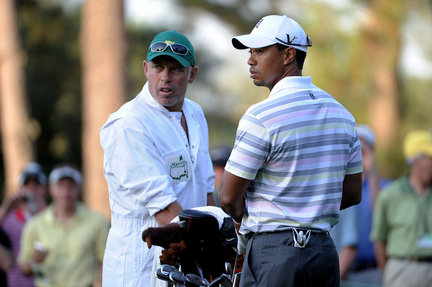 Golf voice Jim Nantz wondered aloud about the reception for Tiger Woods as he walked up the fairway on No. 18 during his first round Thursday at The Masters. (It was golf claps all around, maybe even loud golf claps.)
Nantz then said the reception for the world's No. 1 golfer had been kind all day long.
After Woods' round, Mike Tirico did the obligatory interview in Butler Cabin at Augusta National and asked Woods the necessary questions about his nerves and the way he was treated on the course.
Both Nantz and Woods did what they had to do but, really, honestly, was anyone expecting anything but a cordial, even warm, reception for Woods at The Masters? And, really, honestly, was anyone expecting him to struggle after his layoff?
While we repeatedly heard that Woods had endured 20 weeks without golf, it's not as if he was unable to practice during that time. In fact, he told Tirico that focused practice sessions were the key to his strong performance -- his first sub-70 opening round at The Masters.
What people saw Thursday -- and they saw every possible shot from the time ESPN began its coverage at 4 p.m. until it concluded around 7:35 p.m. with the Tirico-Woods interview -- was a more focused Woods. And that means a productive golfer, as always.
Still, what's most surprising about the coverage was all the surprise from TV commentators -- the experts and our supposed on-site eyes and ears on site at the tournament, and on the tour itself. They're supposed to know the golfers, the tour and all the subplots we do not.
With Woods immediately in contention, just two shots back after the first round, and the on-air types seemingly surprised by what had happened, those at home knew just as much as those working the hallowed grounds in Georgia. Hopefully, we'll get more insights, some quality insights, in succeeding rounds of the tournament.
Ad Allows Nike, Woods to Do It
Nobody expected Tiger Woods and the business partners and sponsors who stood beside him during his much-publicized off-course problems to never return to the business of making money -- and the first ad unveiled for The Masters proved Nike and Woods were not above addressing the issue directly in order to capitalize.
The ad uses the voice of Woods' late father to ask the golfer questions as he looks directly into the camera.
It's certainly a striking and well-constructed commercial, and it's already generating both positive and negative reaction -- a goal for any sports marketer.
What's troubling, though, is that while Woods professes to want to put the off-course character/marital issues behind him and change, we get a commercial (controlled by him and his handlers) that takes advantage of the issue in a manner that only he can. It almost seems like an in-your-face swing at those who've questioned him, again putting him clearly in charge.
Granted, any commercial that was just golf-related would draw criticism as avoiding the issue, but this approach almost seems too strong.
As The Masters Begins, It's (Correctly) Just Golf
 When Tiger Woods tees off at 1:42 p.m. Thursday, ESPN will have the shot live.
Then, at 4 p.m., as the all-sports network begins its first-round coverage of The Masters and the world's best and most-talked-about golfer completes his round, almost all his other shots will be show live as well.
Judging by the comments of on-air talent and behind-the-scenes folks for both ESPN, which carries the tournament's first and second rounds Thursday and Friday, and CBS Sports, which carries the third and fourth rounds on Saturday and Sunday, it will be golf on TV and nothing more with Woods this weekend.
While ESPN gets the first opportunity at the story of Woods' return to competition (and it could be the only opportunity of he were to somehow miss the cut and miss weekend action, although that's unlikely), there's no sense of urgency to share that story. They certainly will not dwell on the infidelity, stint in sex rahab or much else.
In a teleconference earlier this week, ESPN host said "no one's bigger than The Masters" and ESPN executive vice president John Wildhack said the tournament is "THE story line, and we're here to cover The Masters tournament."
Likewise, in an separate teleconference earlier this week, Jim Nantz said nearly a half dozen times in the span of a half-hour phone call with CBS Sports talent and production staff that they would be in Augusta, Ga., to cover a golf tournament, not conduct a "studio show."
Both Nantz and Tirico are correct. At this point, the Woods story should move to his performance on the golf course. While some critics want background, context or perspective about Woods' off-course life and what happened last fall that cost him millions of dollars in sponsorship and possibly his marriage, to dwell on those aspects would be irresponsible and wrong.
Sure, they need mentioned, probably when we viewers first meet Woods again on a telecast. After that, though, it would be overkill. Most viewers no longer care about the specifics -- they either know they'll never know or have finally come to the realization that there's no need for him to know.
Still, Woods will be front and center Thursday and Friday -- as least as much as ESPN can put him front and center in a responsible manner -- because he remains golf's overriding personality and story. His news conference from Augusta National on Monday drew higher TV ratings than all the tournaments on the Golf Channel last year.
People -- that's patrons if you're watching The Masters -- want the golf story, though. And both ESPN and CBS Sports seem more than happy to oblige.
Tuesday, April 6, 2010
Championship Game Scores for CBS Sports
 Underdog Butler and proven TV power Duke drove ratings for Monday night's championship game of the NCAA Tournament 34 percent higher than last year's championship game.
Butler-Duke pulled a 16.0 household rating and a 25 share -- up from 11.9/19 for North Carolina-Michigan State in 2009.
According to CBS Sports, the Butler-Duke numbers tied 2005 (North Carolina-Illinois) as the highest-rated game in metered markets since 1999 (UConn-Duke).
Not surprisingly, Butler-Duke drew its highest ratings from 11:30 to 11:45 p.m., with 20.3/35.
With the championship game, the average overnight ratings for the tournament was 6.6/14, a 5 percent increase over last year. That makes the just-completed tournament the highest rated overall since 2005, which averaged 6.9/15.
In terms of the national championship telecast itself, CBS Sports provided accurate and enjoyable coverage. Analyst Clark Kellogg has seemingly developed more of a comfort level being critical on a big stage (although he rarely disagreed with any fouls called) and the production stayed away from any easy and lazy "Hoosiers" or Cinderella/underdog storylines.
Yes, there was one bit of "Hoosiers" music and collage of images late in the game, but it was not over the top.
While play-by-play man Jim Nantz and Kellogg talked about the atmosphere in Lucas Oil Stadium a couple of times -- with Nantz asking his partner "Have you ever seen as scene like this?" -- the atmosphere did not transfer well to viewers at home. It seemed no more loud or raucous than any other championship basketball game.
Later, Kellogg guessed wrong when he suggested that Duke would shoot early in a possession late in the game. At the time the Blue Devils were up, so it seemed to make sense that they'd hold the ball a bit before shooting. That was one of the few missteps during the telecast, though.
Technically, the only problem seemed to be an overuse of high overhead cameras that provided an unfamiliar angle on game action. While the typical sideline shot was slightly higher because of camera placement in the stadium, it was hard to tell any difference by what showed up on screen. Too often, though, the production team selected shots from even higher cameras that hung over the court.
They seemed like something that would be a fine selection for diagramming a play or providing a slow motion recap of action that had happened, but for live action the angle was just different enough that it seemed uncomfortable. It was not a bad view, just something not typical of a basketball game and trotting it out during the national championship game seemed that it was more a matter of utilizing bells and whistles as opposed to providing a comfortable or familier viewing experience for fans at home.
Monday, April 5, 2010
Slight Ratings Rise Rare for Tournament
 Ratings for Saturday's national semifinals doubleheader on CBS Sports were their highest in several years, and ratings for the entire NCAA Tournament are up slightly, according for information from the network.
The combined numbers for both games Saturday drew a 9.7 rating and a 19 share, up 8 percent from last year and the highest for those games since 2005. Both games were up 8 percent from last year.
Coverage of the tournament overall is up 2 percent for CBS Sports, drawing an average rating of 6.2 and a viewing share of 13 percent.
If the overall numbers hold up -- and they certainly should with initial interest in tonight's matchup between underdog Butler and TV favorite Duke, unless the Blue Devils somehow take control of the game and viewers become less interested late in the game -- the tournament would finish as the highest-rated for CBS Sports since 2005.
Still, ratings for the event have generally been on a slide the past half decade. In the decade after CBS Sports started televising the tournament in 1982, ratings were usually in the 9s with shares in the low 20s.
Since 1994, final average ratings have never been higher than 8.3 (and that happened only in 1994) with shares of 19 (again, that high-water mark was in 1994). The tournament has instead trended down, thanks to changing viewing habits and the proliferation and splintering of U.S. television viewing options.
Ratings have slippped from 7s and 6s to 5.7 last year while shares have slid from 17s to 15s and a 12 last year.
This season's numbers would represent an important, albeit rare, uptick -- coming at an interesting time, because this could be the final championship game on CBS Sports if a much-rumored change in the tournament format happens. According to indications, the NCAA might opt out of its contract with CBS Sports and rebid the event, with ESPN has the generally accepted primary suitor.
The numbers beg all kinds of questions -- not the least of which is why ESPN would want to pay more for something that's drawing less TV attention and viewers. On top of that, any revamped tournament (96 teams) would seemingly water down ratings and shares even more by adding more content to a seemingly oversaturated market.
Because of its ability to charge cable customers directly, though, ESPN has a better model to produce the revenue the money-hungry NCAA wants for its men's basketball tournament. It has to be concerning so someone, though, that the since 2005 the tournament lost nearly 13 million viewers, according to total audience estimates by CBS Sports.
In 2005, the latest high-water mark was 141.7 million viewers for the tournament. In 2009, those same estimates were at 128.9 million viewers. That's a 9 percent drop in viewers in just five years.
Thursday, April 1, 2010
Techno Tackles Stadium Size at Final Four
INDIANAPOLIS -- In its basketball configuration, Lucas Oil Stadium in Indianapolis, site of the Final Four national semifinals Saturday and national championship game Monday, seats 70,000 people -- with all those people spread across the expanse of the stadium focused on a hardwood area 94-feet long by 50-feet wide.
Not many people will be really close to the action.
CBS Sports will not have many camera operators or hand-held camers close to the court, either.
"The NCAA has helped us get closer to the court," said director Bob Fishman. "Our main play-by-play camers are farther away, but we're going to have cameras all over the court -- robotic cameras."
Long, powerful lenses will make the game action from the primary play-by-play cameras look no different than what college basketball fans typically see on TV, and with robotic cameras stationed all over the place (attached to the backboards, tables on the baseline and even near the benches), fans should see all they want of the three remaining games of the season.
Howard Bryant, vice president of production for CBS Sports, calls the cameras focused on the benches "the big ad" for the Final Four. As the NCAA Tournament progresses and games become more and more important, CBS Sports typically adds more gizmos and technology to cover the games.
Another difference this weekend is the location of the court. Last season the court was centered on the football field at Ford Field in Detorit, and that'll be the same again this year. It's the first time basketball games have been played with that configuration at Lucas Oil Stadium, though. Previous games here, whether part of a regular season doubleheader with Indiana or as part of an NCAA Regional, all featured the hardwood positioned in an end zone of the football field.
Subscribe to:
Posts (Atom)